Kit Lens
Lumix S 20-60mm f/3.5-5.6 — weird range, but amazing for wide vlogging.
The camera that fixed Panasonic's biggest flaw. Finally with reliable autofocus, plus class-leading stabilization and video features.
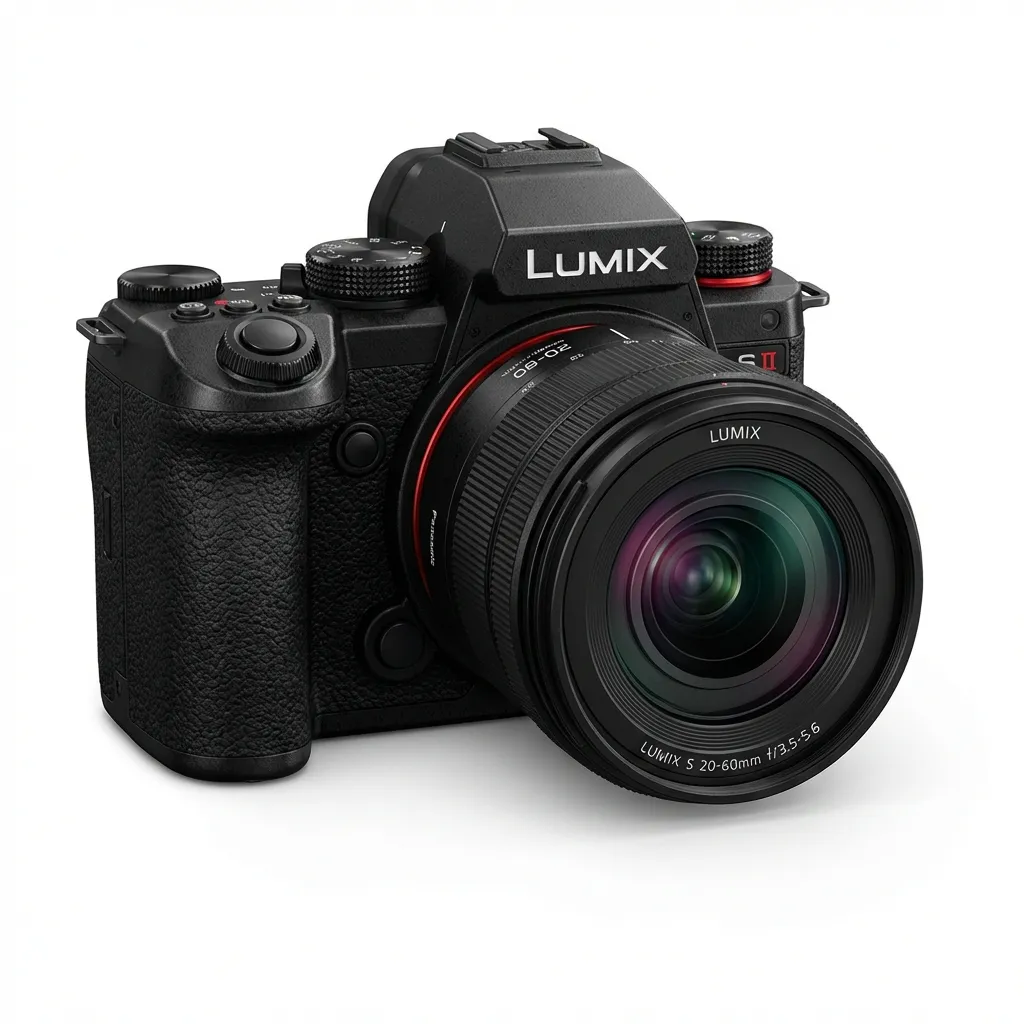
For years, Panasonic cameras had amazing video specs but terrible autofocus. The S5 II changed everything by adding **Phase Detect AF**.
It combines this new customized AF with the best In-Body Image Stabilization (IBIS) in the business. You can walk and talk without a gimbal, and shoot 6K video that looks like a cinema camera. For solo filmmakers, this is the one to beat.
| Imaging | |
|---|---|
| Sensor | 24.2MP Full-Frame CMOS |
| Processor | L2 Technology (New Engine) |
| Stabilization | 5-Axis IBIS (6.5 stops with Dual I.S. 2) |
| ISO Range | 100-51,200 (exp. 50-204,800) |
| Autofocus | |
| AF Points | 779 Phase-Detection Points |
| AF System | Phase Hybrid AF (Phase + Contrast) |
| Burst Speed | 30 fps (Electronic), 9 fps (Mechanical) |
| Video | |
| Max Resolution | 6K 30p Open Gate (3:2) / 4K 60p |
| Internal Rec | 10-bit 4:2:2 (LongGOP / All-Intra) |
| Profiles | V-Log (14+ stops), V-Gamut, HLG |
| Video Features | Real-time LUT, Waveform, Vector Scope |
| Build & Connectivity | |
| Viewfinder | 3.68M-dot OLED EVF (0.78x mag) |
| Screen | 3.0" Free-angle Touch (1.84M-dot) |
| Card Slots | Dual SD UHS-II |
| Ports | Full HDMI, USB-C (PD), Mic, Headphone |
| Weather Sealing | Dust and Splash Resistant |
| Weight | 740g (with battery and card) |
The 24.2-megapixel full-frame CMOS sensor delivers excellent image quality with good dynamic range (approximately 13.5 stops at base ISO). The dual native ISO (640 and 4000) minimizes noise at common video ISOs, making this camera exceptionally clean in low light. Color science is pleasing and natural, with skin tones that require minimal correction.
High-ISO performance is outstanding—ISO 6400 produces clean, professional-grade images and ISO 12800 remains highly usable. The Venus Engine processor handles noise reduction intelligently, preserving detail while smoothing noise. For challenging lighting situations (concerts, events, nighttime), the S5 II is among the best performers in its class.
The S5 II represents a complete transformation for Panasonic. The new phase-detect AF system eliminates the "hunting" and "pulsing" focus behavior of previous Panasonic cameras. 779 AF points cover the entire frame, with subject detection for humans (face/eye/body), animals, and vehicles.
Tracking is smooth and reliable for video work—precisely what videographers need. For single-person interviews or vlogging, autofocus is essentially flawless. For fast-action sports, it's not quite at Sony's level, but for 95% of video work, the AF performs with professional reliability. The improvement over the original S5 is transformative.
The S5 II shoots stunning 6K 30p Open Gate video using the entire sensor area (3:2 aspect ratio). This enables flexible reframing in post—extracting 16:9 horizontal AND 9:16 vertical content from a single clip. For creators shooting for multiple platforms, this workflow is invaluable. V-Log provides approximately 14 stops of dynamic range for color grading.
Internal recording is 10-bit 4:2:2 with unlimited recording time thanks to the built-in cooling fan. The fan is nearly silent and prevents overheating entirely. 4K 120p is available for buttery slow motion. ProRes recording requires the S5 IIX variant, but for most creators, the standard codec options are more than sufficient.
Panasonic's Active I.S. is among the best in the industry. The system combines 5-axis IBIS (rated 8 stops) with electronic stabilization for remarkably smooth handheld footage. Walking shots that would require a gimbal on other cameras are achievable handheld on the S5 II. This single feature is a game-changer for solo filmmakers.
Build quality is robust with magnesium alloy construction and comprehensive weather sealing. The deep grip accommodates all-day shooting with heavy lenses. The 3.0" free-angle touchscreen and 2.36M-dot EVF are functional if not class-leading. Battery life drains faster in high-res modes, so spare batteries are essential. Weight (740g) is heavier than Sony/Canon equivalents but feels balanced.
Lumix S 20-60mm f/3.5-5.6 — weird range, but amazing for wide vlogging.
Lumix S 50mm f/1.8 — affordable, light, and sharp.
Sigma 24-70mm f/2.8 DG DN Art (L-Mount) — the workhorse lens.
We buy our own gear or rent it. No manufacturers paid for this review. We earn a commission if you use our links, which keeps this site ad-free.
| Spec | Panasonic S5 II ★ | Sony A7 IV | Canon R6 II |
|---|---|---|---|
| Price | $1,997 | $2,498 | $2,499 |
| Sensor | 24.2MP FF | 33MP FF | 24MP FF |
| Video | 6K30 | 4K60 | 4K60 |
| AF Points | 779 points PDAF | 759 points | 1053 zones |
| Burst | 30 fps | 10 fps | 40 fps |
| IBIS | 6.5 stops | 5.5 stops | 8 stops |
Essential gear to maximize your Panasonic Lumix S5 II experience:
Required for 6K and high bitrate 4K.
Large capacity batteries for video work.
Versatile range with great stabilization.
Essential for rigging monitors and mics.
The biggest upgrade is phase-detect autofocus—the original S5 had slow contrast-detect AF. The S5 II also adds USB-C recording, improved IBIS (8 stops), and better heat management. It's a completely different camera in terms of usability.
Not anymore. Sigma, Leica, and Panasonic all make L-mount lenses. You have access to affordable Sigma Art lenses and high-end Leica glass. Third-party options from TTArtisan and Viltrox expand choices further. L-mount is smaller than Sony E or Canon RF, but growing steadily.
The IIX is identical hardware with unlocked video features: ProRes RAW, waveforms, and USB-C RAW output. If you're a serious video creator, the IIX is worth the extra $500. For hybrid shooters or photo-focused users, the standard S5 II is plenty.
Slightly better. The S5 II maxes at ISO 204,800 (vs 102,400 on A7 IV) and produces cleaner files at high ISOs. The dual native ISO design (ISO 640 and 4000) means noise is minimal at common video ISOs. For nighttime event shooting, the S5 II has an edge.
For many creators, yes. Unlimited 6K recording, 10-bit 4:2:2 internal, and V-Log make it a legitimate cinema tool. It lacks built-in ND filters and XLR inputs (requires DMW-XLR1 adapter), but the image quality rivals cameras 3-4x the price. Pair it with a Ninja V for ProRes recording.

Our team of professional photographers and videographers has 10+ years of experience testing cameras. We buy our own gear and provide honest, unbiased reviews.
Learn more about our testing process →