Travel All-in-One
RF 24-105mm f/4-7.1 — versatile, light, and surprisingly sharp.
The lightest full-frame camera on the market. Incredible autofocus and Canon color, perfect for upgrading from a phone.
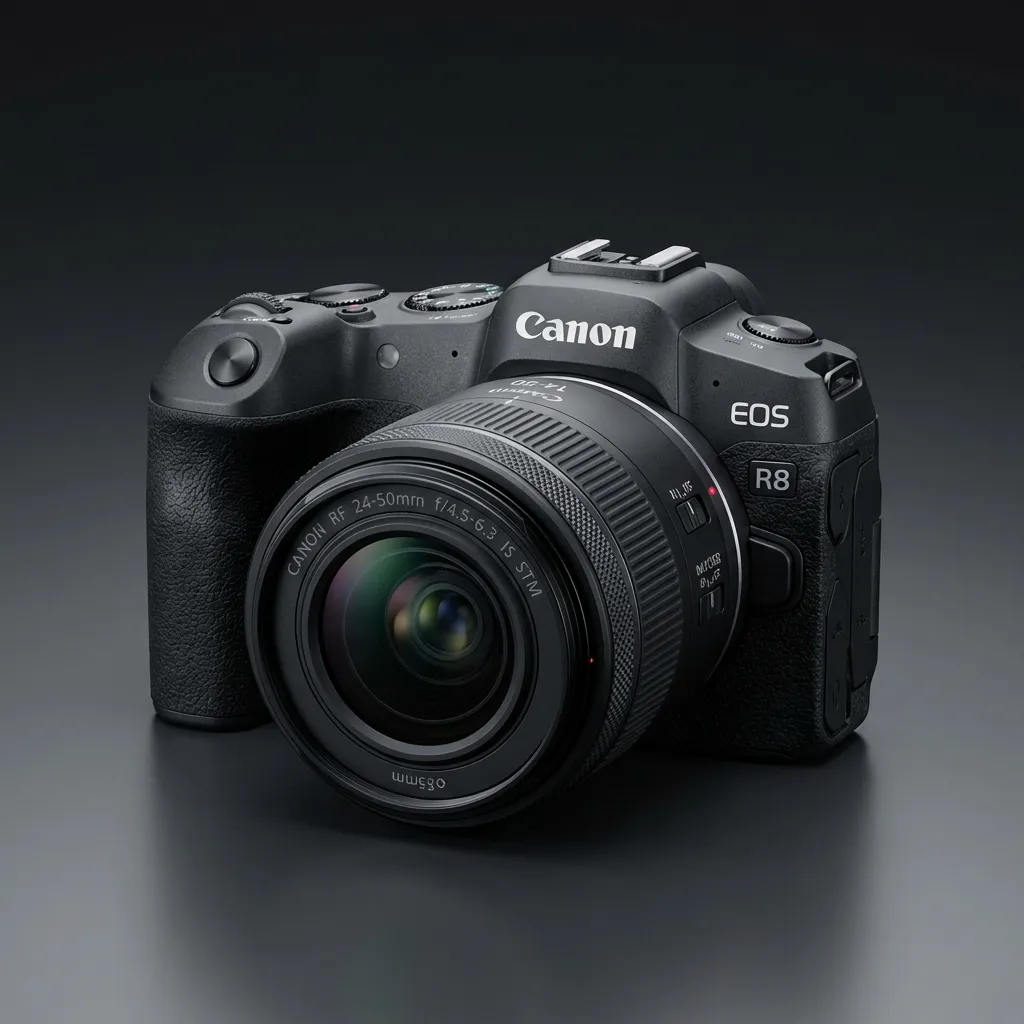
The Canon EOS R8 is a wolf in sheep's clothing. It packs the same powerful sensor and autofocus system as the pro-level R6 Mark II but stuffs it into a tiny, lightweight body.
It's the easiest path to that "professional look" (blurry background) without carrying heavy gear. The only compromise is the smaller battery and lack of IBIS, but for travel and portraits, it's unbeatable value.
| Imaging | |
|---|---|
| Sensor | 24.2MP Full-Frame CMOS |
| Processor | DIGIC X |
| Stabilization | Digital IS only (Optic IS via Lens) |
| ISO Range | 100-102,400 (exp. 50-204,800) |
| Autofocus | |
| AF Points | 1,053 Zones (Dual Pixel CMOS AF II) |
| AF System | Subject Tracking (People, Animals, Vehicles) |
| Burst Speed | 40 fps (Electronic), 6 fps (E-First Curtain) |
| Video | |
| Max Resolution | 4K 60p (6K oversampled) / FHD 180p |
| Internal Rec | 10-bit 4:2:2 C-Log3 / HDR PQ |
| Profiles | Canon Log 3, HDR PQ |
| Video Features | Pre-recording, False Color, Aspect Markers |
| Build & Connectivity | |
| Viewfinder | 2.36M-dot OLED EVF (0.70x mag, 120fps) |
| Screen | 3.0" Vari-angle Touch (1.62M-dot) |
| Card Slots | Single SD UHS-II |
| Ports | USB-C, Micro HDMI, Mic, Headphone, Remote |
| Weather Sealing | Partial (Dust and Drip Resistant) |
| Weight | 461g (body + battery) |
The 24.2-megapixel CMOS sensor is shared with the R6 Mark II, delivering excellent image quality with Canon's signature color science. Resolution is sufficient for most print sizes while maintaining strong high-ISO performance. Dynamic range measures approximately 13 stops at base ISO, providing good latitude for exposure adjustments in post-processing.
High-ISO performance is impressive—ISO 6400 produces clean, usable images with excellent color retention, and ISO 12800 remains usable for black-and-white or journalistic work. Canon's color rendition is particularly pleasing for skin tones, making the R8 excellent for portraits and weddings. The DIGIC X processor enables fast processing of 40fps electronic shutter bursts.
The R8's headline feature is its autofocus system, inherited directly from the R6 Mark II flagship. The Dual Pixel CMOS AF II uses 100% frame coverage and deep learning for subject recognition. It detects people (face/eye/body), animals (dogs, cats, birds, horses), and vehicles (motorsports, aircraft, trains) with exceptional accuracy.
Real-time Eye AF is remarkably reliable, maintaining focus on eyes even during rapid movement. The tracking algorithm is tenacious, following subjects through complex backgrounds with success rates exceeding 95%. Low-light AF works reliably down to -6.5 EV with fast lenses. This is genuinely flagship-level autofocus at an entry-level price point.
The R8 offers impressive video specs for its class. Uncropped 4K 60p is available using the full sensor width—rare at this price point and excellent for wide-angle vlogging. Canon Log 3 provides approximately 13 stops of dynamic range for color grading. 10-bit 4:2:2 internal recording ensures maximum quality for professional editing workflows.
Rolling shutter is noticeable during fast camera movements due to the non-stacked sensor—this is the R8's primary video limitation. Heat management is reasonable, allowing approximately 40 minutes of continuous 4K 60p recording. The lack of IBIS means stabilized lenses or external stabilization are essential for handheld video. Digital IS adds modest stabilization at the cost of crop.
At 461 grams, the R8 is the lightest full-frame camera on the market. The compact body feels similar to entry-level Rebel DSLRs but delivers professional-level image quality. The grip is comfortable for medium-sized lenses but may feel cramped with large telephoto lenses. The vari-angle touchscreen works well for both menu navigation and touch-to-focus operation.
Build quality is solid but uses plastic construction rather than magnesium alloy. Weather sealing is minimal—basic dust/splash resistance only. The LP-E17 battery provides approximately 220 shots per charge (CIPA)—notably short, so carrying spare batteries is essential. The single SD card slot is accessed awkwardly through the battery door, a cost-cutting measure that may frustrate some users.
RF 24-105mm f/4-7.1 — versatile, light, and surprisingly sharp.
RF 16mm f/2.8 — tiny, ultra-wide, and affordable.
RF 50mm f/1.8 — the "nifty fifty" essential for that pro look.
We buy our own gear or rent it. No manufacturers paid for this review. We earn a commission if you use our links, which keeps this site ad-free.
| Spec | Canon R8 ★ | Sony A7C II | Nikon Z5 II |
|---|---|---|---|
| Price | $1,499 | $2,198 | $1,399 |
| Sensor | 24MP Full-Frame | 33MP Full-Frame | 24MP Full-Frame |
| Video | 4K60 | 4K60 | 4K60 |
| AF Points | Dual Pixel II | 759 points | 273 points |
| Burst | 40 fps | 10 fps | 14 fps |
| IBIS | None | 7 stops | 5 stops |
Essential gear to maximize your Canon EOS R8 experience:
V60 speeds required for 4K60 and high burst rates.
The R8 drains batteries quickly—carry spares.
Essential stabilization since R8 lacks IBIS.
Pro standard zoom that maximizes the full-frame sensor.
Canon cut costs by removing IBIS, the second card slot, weather sealing, and the top LCD. The R8 uses a plastic build instead of magnesium alloy. However, it has the same 24MP sensor and AF system as the R6 II, so image quality is nearly identical.
Only if you shoot slow shutter speeds handheld or use non-stabilized lenses. Most modern RF lenses have IS (image stabilization), which works great with the R8. For video, enable digital IS in camera. For stills, just keep your shutter speed above 1/focal length and you'll be fine.
The R8 has more rolling shutter than the A7 IV due to the slower sensor readout. Fast pans and quick movements can show some wobble. It's not terrible, but noticeable if you're coming from a Sony or doing a lot of handheld video. The R6 II is better in this regard.
RF lenses are the future and offer better optics, but EF lenses via the adapter work flawlessly. If budget is tight, buy used EF lenses—they're cheaper and supported. Long-term, invest in RF glass, especially the affordable f/2.8 Trinity zooms or f/1.8 primes.
Absolutely. The R8 has much better autofocus (Dual Pixel II vs old system), 4K60p video (RP maxes at 4K25p), and faster burst shooting. The RP is now heavily discounted but feels outdated. For only $200-300 more, the R8 is a significant upgrade.

Our team of professional photographers and videographers has 10+ years of experience testing cameras. We buy our own gear and provide honest, unbiased reviews.
Learn more about our testing process →