
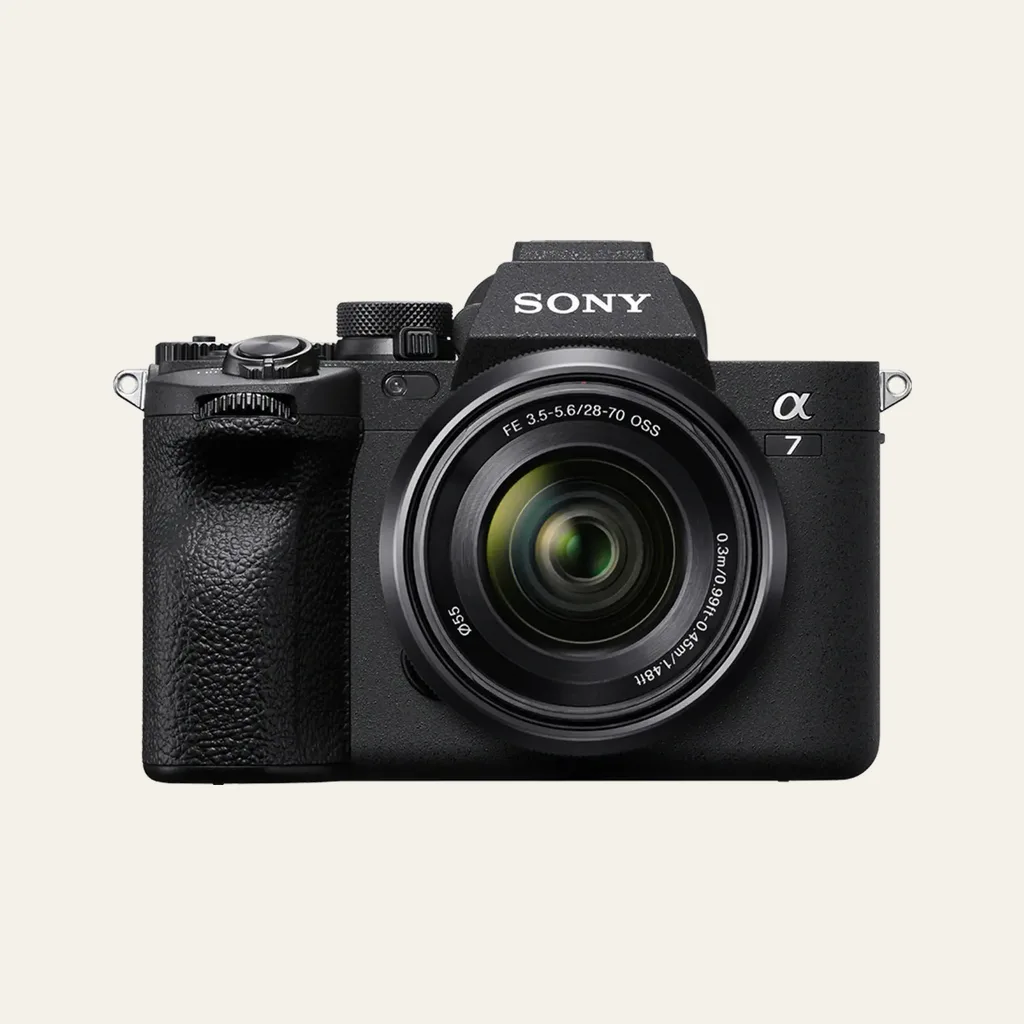
Sony A7 III
Our score: 7.7/10
No sub-score higher than the Sony A7 IV's.
Sensor 24MP FF
Video 4K30
IBIS 5 stops
Burst 10 fps
Same NP-FZ100 battery, the same approx. 10 fps top burst rate and the same 0.78x viewfinder magnification. The A7 IV moves to 33MP, a 3.69M-dot viewfinder, a vari-angle screen, CFexpress Type A and 10-bit 4:2:2 video; the A7 III is rated for more shots per charge, 710 against 580.
Updated: November 2026

Links to retailers on this page are affiliate links. We earn a commission on purchases made through them, at no extra cost to you. It doesn't change our verdicts.
Our score: 7.7/10
No sub-score higher than the Sony A7 IV's.
Our score: 8.3/10
Higher score than the Sony A7 III:
| Specification | Sony A7 III | Sony A7 IV |
|---|---|---|
| Sensor | 24.2MP full-frame Exmor R CMOS, 35.6 × 23.8 mm (approx. 24.2 million effective pixels) | 33MP full-frame Exmor R CMOS, 35.9 × 23.9 mm (approx. 33 million effective pixels) |
| Image size | 6,000 × 4,000 | 7,008 × 4,672 |
| Stabilisation | Sensor-shift, 5-axis; 5.0 stops (CIPA, pitch/yaw, with the Planar T* FE 50mm F1.4 ZA) | Sensor-shift, 5-axis; 5.5 stops (CIPA, pitch/yaw, with the Planar T* FE 50mm F1.4 ZA) |
| Autofocus | Phase and contrast detection; 693 phase-detection points (full frame); Eye AF for humans and animals (firmware 3.00 or later); –3 to +20 EV | Phase and contrast detection; 759 phase-detection points (full frame); Eye AF for humans, animals and birds; –4 to +20 EV |
| Burst | Approx. 10 fps (Hi+), 8 (Hi), 6 (Mid), 3 (Lo), under Sony's measurement conditions; no real-time display in Hi+ | Approx. 10 fps (Hi+), 8 (Hi), 6 (Mid), 3 (Lo), under Sony's measurement conditions; no real-time display in Hi+ |
| Buffer (Hi+) | Approx. 89 compressed RAW, 40 uncompressed RAW, 177 JPEG (Standard) | Approx. 1,000 or more compressed RAW; 828 uncompressed RAW + JPEG; with a Sony CEA-G160T CFexpress Type A card |
| Shutter | 1/8,000 s to 30 s, bulb; flash sync 1/250 s | 1/8,000 s to 30 s, bulb; flash sync 1/250 s (full frame), 1/320 s (APS-C) |
| ISO | Stills 100–51,200 (expandable to 50–204,800) | Stills 100–51,200 (expandable to 50–204,800) |
| Video | 4K (3,840 × 2,160) at 30p/25p/24p, approx. 100 or 60 Mbps, XAVC S; 4K 30p at approx. 1.2x in full-frame shooting; Full HD up to 120p | 4K (3,840 × 2,160) up to 60p, 4:2:2 10-bit available, XAVC HS / XAVC S / XAVC S-I up to 600 Mbps; 4K 60p/50p in Super 35 (approx. 1.5x); Full HD up to 120p |
| Picture profiles | PP1–PP10: S-Log2, S-Log3, HLG | PP1–PP11: S-Cinetone, S-Log2, S-Log3, HLG |
| Recording time | Approx. 29 min per clip (product specification limit); 4K 24p 60M approx. 29 min at 20–40 °C, Auto Power OFF Temp. Standard | Approx. 13 h per session (product specification limit); 4K 30p 60M approx. 10 min at 25 °C on Standard, approx. 120 min on High |
| HDMI | Micro HDMI (Type D); 4K 30p/24p out as YCbCr 4:2:2 8-bit | Full-size HDMI (Type A) |
| Viewfinder | 1.3 cm (0.5-type), 2,359,296 dots, approx. 0.78x | 1.3 cm (0.5-type), 3,686,400 dots, approx. 0.78x |
| Rear screen | 3.0-inch, 921,600 dots, touch; tilts up approx. 107°, down approx. 41° | 3.0-inch, 1,036,800 dots, touch; vari-angle, opens approx. 176°, rotates approx. 270° |
| Card slots | 1x SD (UHS-I/UHS-II) + 1x Memory Stick PRO Duo / SD (UHS-I) | 1x CFexpress Type A / SD (UHS-I/UHS-II) + 1x SD (UHS-I/UHS-II) |
| USB | USB-C (USB 3.1 Gen 1) and Multi/Micro USB | USB-C (10 Gbps, USB 3.2, USB Power Delivery) and Multi/Micro USB |
| Wi-Fi | 802.11 b/g/n, 2.4 GHz; Bluetooth 4.1 | 802.11 a/b/g/n/ac, 2.4 / 5 GHz (model WW734234; 2.4 GHz only on WW454361); Bluetooth 4.1 |
| Battery | NP-FZ100, approx. 710 shots (screen), 610 (viewfinder), CIPA | NP-FZ100, approx. 580 shots (screen), 520 (viewfinder), CIPA |
| Weight | 650 g (with battery and card); 565 g body only | 658 g (with battery and card); 573 g body only |
| Dimensions | 126.9 × 95.6 × 73.7 mm | 131.3 × 96.4 × 79.8 mm |
Spec figures from the makers: Sony A7 III (helpguide.sony.net, checked 19 Nov 2026) · Sony A7 IV (sony.co.uk, checked 25 Sept 2026)
Stabilisation ratings, screen angles, phase-detection point counts, picture profiles, body-only weights and the A7 III's HDMI output format are from Sony Japan's specification pages (ILCE-7M3, ILCE-7M4); the rest is from Sony's Help Guides for each camera.
| Spec | Sony A7 III | Sony A7 IV |
|---|---|---|
| Sensor | 24MP FF | 33MP FF |
| Video | 4K30 | 4K60 |
| AF Points | 693 points | 759 points |
| Burst | 10 fps | 10 fps |
| IBIS | 5 stops | 5.5 stops |
| Buy | Check price at Amazon (affiliate link) | Check price at Amazon (affiliate link) |
The A7 III's full-frame sensor measures 35.6 × 23.8 mm with approx. 24.2 million effective pixels and records 6,000 × 4,000 images. The A7 IV's measures 35.9 × 23.9 mm with approx. 33 million and records 7,008 × 4,672, which is 1,008 more pixels across. Sony gives both the same ISO range: 100–51,200 for stills, expandable to 50–204,800.
The A7 III writes JPEG and RAW, compressed or uncompressed. The A7 IV adds HEIF and a lossless compressed RAW option.
Our read: the A7 IV, for the extra resolution.
The A7 III records 4K (3,840 × 2,160) at up to 30p, at approx. 100 or 60 Mbps in XAVC S. In full-frame shooting, 4K 30p uses a narrower angle of view, approx. 1.2 times the focal length, per Sony's Help Guide. Full HD goes up to 120p. Sony lists no 10-bit setting for it; Sony Japan gives its 4K HDMI output as YCbCr 4:2:2 8-bit.
The A7 IV records 4K at up to 60p and offers 4:2:2 10-bit in camera, in XAVC HS, XAVC S and the intra-frame XAVC S-I at up to 600 Mbps. At 4K 60p/50p it switches to the Super 35 angle of view, approx. 1.5 times the focal length. It adds the S-Cinetone gamma to the S-Log2, S-Log3 and HLG gammas both cameras have. The A7 IV has a full-size HDMI (Type A) port; the A7 III has micro HDMI (Type D).
Sony states recording time differently for each. The A7 III stops a clip at approx. 29 minutes, a product specification limit; with Auto Power OFF Temp. at Standard, Sony gives approx. 29 minutes of 4K 24p 60M from a cold start at 20, 30 and 40 °C. The A7 IV's specification limit is approx. 13 hours per session, but at Standard Sony gives approx. 10 minutes of 4K 30p 60M at 25 °C and at 40 °C (CFexpress Type A card, monitor open). Set to High, Sony gives approx. 120 minutes at 25 °C and approx. 30 minutes at 40 °C.
Our read: the A7 IV, for 10-bit and 4K 60p; its 4K 60p is a Super 35 crop.
The A7 IV's viewfinder has 3,686,400 dots against the A7 III's 2,359,296; magnification is approx. 0.78x on both. The A7 IV's 3.0-inch screen has 1,036,800 dots and is vari-angle: Sony Japan gives approx. 176° to open and approx. 270° to rotate. The A7 III's 3.0-inch screen has 921,600 dots and tilts up approx. 107° and down approx. 41°. Both are touch screens.
Slot 1 on the A7 III takes SD (UHS-I and UHS-II), slot 2 Memory Stick PRO Duo or SD (UHS-I only). On the A7 IV, slot 1 takes CFexpress Type A or SD and slot 2 SD, with both SD slots UHS-I and UHS-II. USB-C is USB 3.1 Gen 1 on the A7 III and 10 Gbps (USB 3.2) with USB Power Delivery on the A7 IV.
Sony Japan rates the stabilisation at 5.0 stops for the A7 III and 5.5 stops for the A7 IV, both to CIPA (pitch/yaw) with the Planar T* FE 50mm F1.4 ZA attached.
Both reach approx. 10 fps in Hi+, and on both Sony notes that the subject is not displayed in real time in Hi+. The buffer differs: Sony gives the A7 III approx. 89 compressed RAW frames in Hi+ and the A7 IV approx. 1,000 or more, measured with a Sony CEA-G160T CFexpress Type A card. Sony does not name the card for the A7 III figure.
Both use the NP-FZ100 battery. Sony rates the A7 III at approx. 710 shots with the screen and 610 with the viewfinder, the A7 IV at approx. 580 and 520 (CIPA, 25 °C). With battery and card, the A7 III weighs 650 g and the A7 IV 658 g. The shutter range (1/8,000 to 30 s), the full-frame flash sync of 1/250 s and Bluetooth 4.1 are the same on both.
From owner reports. See What owners report in the review.
Check price at Amazon (affiliate link)On our scores out of 10, the Sony A7 III gets 7.7 and the Sony A7 IV 8.3.
The Sony A7 IV scores higher on: Image quality (8.6 vs 8.3), Autofocus (8.9 vs 8.4), Video (7.9 vs 6.6), Speed (7.4 vs 7.2), Handling and build (8.2 vs 7.6).
Full reviews: Sony A7 III, Sony A7 IV
Yes. Sony lists the NP-FZ100 for both cameras. Sony rates it at approx. 710 shots with the screen on the A7 III and approx. 580 on the A7 IV (CIPA).
SD cards do, in either slot. Memory Stick PRO Duo does not: Sony lists only CFexpress Type A and SD cards for the A7 IV.
Sony lists no 10-bit setting for the A7 III, and Sony Japan gives its 4K HDMI output as YCbCr 4:2:2 8-bit. The A7 IV records 4:2:2 10-bit in camera, in 4K up to 60p.
On both, in one mode. The A7 III's 4K 30p in full-frame shooting uses approx. 1.2x the focal length. The A7 IV records 4K 60p/50p in Super 35, approx. 1.5x.
