Wide Lens
Sigma 16mm f/1.4 — for that blurry background look.
The budget legend. Even with a newer model out, the original ZV-E10 remains the best value entry-point for creators.
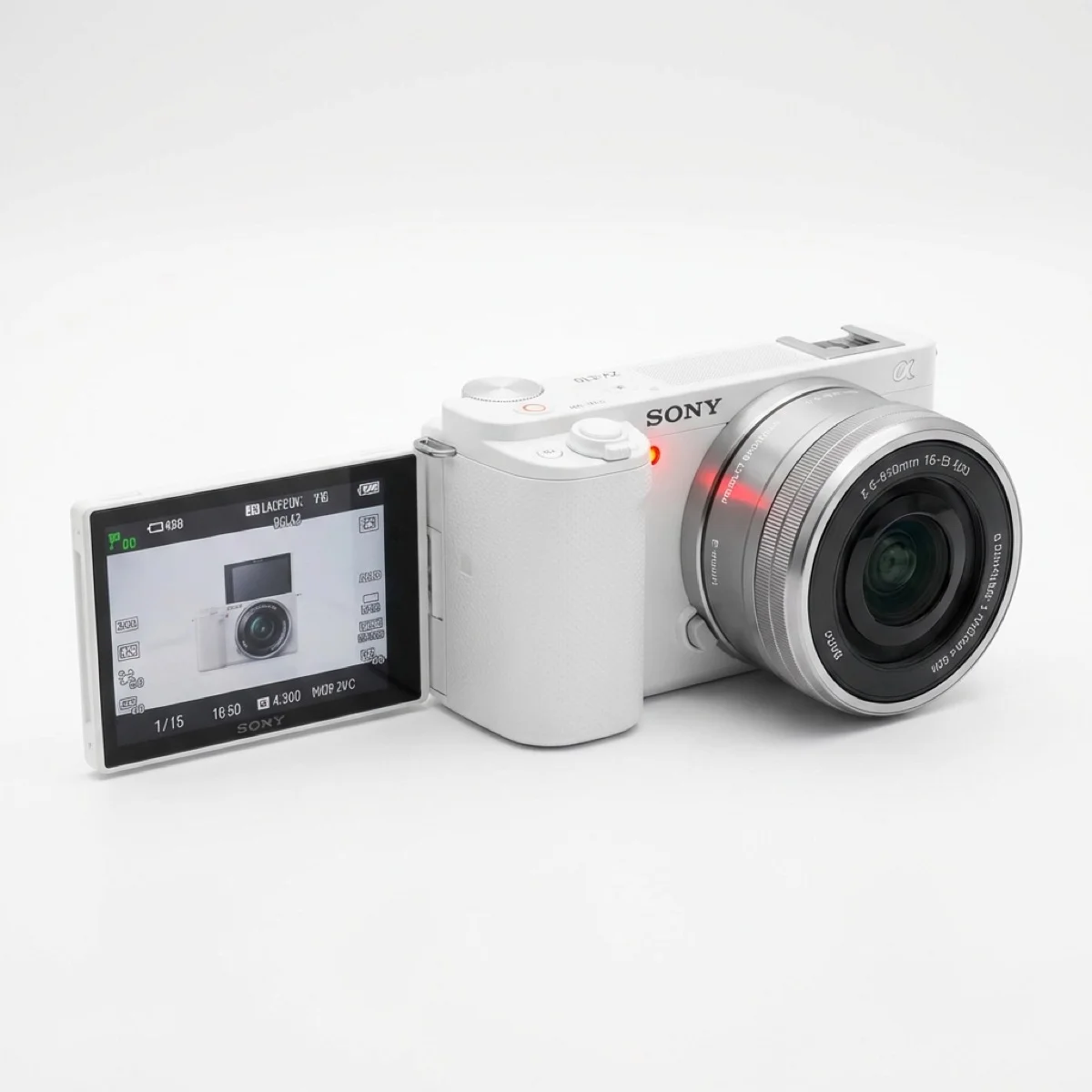
The Sony ZV-E10 changed the game by offering a large APS-C sensor and interchangeable lenses for the price of a compact camera.
While the Mark II is out now, the original ZV-E10 is still the smart buy for beginners on a budget. The autofocus is reliable, the audio (3-capsule mic) is surprisingly good, and access to E-mount lenses means limitless growth potential.
| Imaging | |
|---|---|
| Sensor | 24.2MP APS-C Exmor CMOS |
| Processor | BIONZ X |
| Stabilization | Electronic (Active Mode), Lens OSS |
| ISO Range | 100-32,000 (exp. 50-51,200) |
| Autofocus | |
| AF Points | 425 Phase-Detection Points |
| AF System | Real-time Eye AF (Human/Animal) + Real-time Tracking |
| Burst Speed | 11 fps (Hi+) |
| Video | |
| Max Resolution | 4K 30p (6K oversampled) / FHD 120p |
| Internal Rec | 8-bit 4:2:0 XAVC S |
| Profiles | S-Log2, S-Log3, HLG |
| Video Features | Product Showcase, Background Defocus, Tally Light |
| Build & Connectivity | |
| Viewfinder | None (LCD Only) |
| Screen | 3.0" Vari-angle Touch (0.92M-dot) |
| Card Slots | Single SD (UHS-I) / Memory Stick Duo |
| Ports | USB-C (3.2 Gen 1), Micro HDMI, Mic, Headphone |
| Weather Sealing | No official weather sealing |
| Weight | 343g (with battery) |
The 24.2-megapixel APS-C Exmor CMOS sensor delivers excellent image quality for its class. The sensor is identical to the a6400, providing proven performance with good dynamic range (approximately 12 stops at base ISO) and pleasing color rendition. Still photography is capable though limited by the lack of a viewfinder.
High-ISO performance is solid for APS-C—ISO 3200 produces clean, usable images, and ISO 6400 remains acceptable for low-light situations. With a fast lens (f/1.4), indoor vlogging in moderate lighting is entirely achievable. Color science is Sony's latest, with improved skin tone rendering compared to earlier APS-C models.
Sony's Real-time Eye AF technology provides reliable face and eye tracking for vlogging. The contrast-detection AF system has 425 points covering 84% of the frame. Tracking is accurate for talking-head videos and moderate movement, though not as advanced as the newest Sony bodies with phase-detection AF.
The standout feature is Product Showcase mode—when you hold an object in front of the camera, focus instantly shifts from your face to the product, then back again when you lower it. This single feature makes the ZV-E10 invaluable for YouTube reviewers and product photographers. It works reliably and is remarkably accurate.
The ZV-E10 was designed specifically for content creators. The 3-capsule directional microphone provides surprisingly good audio for indoor vlogs, eliminating the need for an external microphone initially. A front tally light confirms recording status—essential when vlogging. Background defocus mode creates bokeh with a single button press.
Video specifications are solid: 4K 30p with a 1.2x crop, or 1080p 120fps for slow motion. S-Log2 and S-Log3 profiles provide approximately 14 stops of dynamic range. The lack of IBIS means stabilization is digital only (Active Mode adds additional crop). For walking vlogs, pair with a wide lens like the Sony 10-20mm PZ to compensate for the crop.
At 343 grams, the ZV-E10 is remarkably light and compact. The fully articulating vari-angle screen is essential for vlogging, enabling comfortable front-facing composition. There's no electronic viewfinder—this is purely a screen-based camera, which works for its intended video purpose.
Battery life is modest (approximately 440 shots CIPA) due to the small NP-FW50 battery, so carrying spares is essential for extended shoots. USB-C powers the camera indefinitely for livestreaming. The headphone and microphone jacks enable professional audio monitoring. Access to the large E-mount lens ecosystem provides endless growth potential.
Sigma 16mm f/1.4 — for that blurry background look.
Rode Wireless Go II — plugs right into the mic jack.
Sony GP-VPT2BT — wireless grip makes vlogging much easier.
We buy our own gear or rent it. No manufacturers paid for this review. We earn a commission if you use our links, which keeps this site ad-free.
| Spec | Sony ZV-E10 ★ | Sony ZV-E10 II | Canon R50 |
|---|---|---|---|
| Price | $698 | $998 | $679 |
| Sensor | 24MP APS-C | 26MP APS-C | 24MP APS-C |
| Video | 4K30 | 4K60 | 4K30 Crop |
| AF Points | 425 points | 759 points | Dual Pixel II |
| Burst | 11 fps | 11 fps | 15 fps |
Essential gear to maximize your Sony ZV-E10 experience:
Fast enough for 4K30 and burst shooting.
Small batteries drain fast—bring multiple.
Compact shotgun mic for vlogging.
Wide-angle with beautiful bokeh for content creators.
Yes! It's designed specifically for vlogging with a flip screen, Product Showcase mode, and excellent autofocus. The lack of IBIS means you'll need a gimbal or electronic stabilization for walking shots. For stationary talking-head videos, it's unbeatable at this price.
If you can afford it, get the ZV-E10 II. It adds in-body stabilization, better battery life, and AI autofocus. But the original ZV-E10 is still excellent and now costs $200-300 less. For tripod work or gimbal use, the original is a smart budget pick.
The Sony 16-50mm power zoom kit lens is actually good for vlogging—it's lightweight and the power zoom is smooth. For better low-light and bokeh, upgrade to the Sigma 16mm f/1.4 (wide angle for arm's length) or Sony 35mm f/1.8 (tighter framing, more cinematic).
It's decent but not exceptional. The APS-C sensor is smaller than full-frame, so you'll see noise above ISO 3200. With a fast lens (f/1.4) and proper lighting, it handles indoor shooting well. For nighttime vlogging, consider adding a small LED panel.
Yes, using the USB-C port with Sony's Imaging Edge Webcam software (free). It works perfectly with OBS, Zoom, and YouTube Live. The camera can run off USB power indefinitely, so battery life isn't a concern during streams. Quality is far better than any webcam.

Our team of professional photographers and videographers has 10+ years of experience testing cameras. We buy our own gear and provide honest, unbiased reviews.
Learn more about our testing process →