
Nikon Z8 Review
The flagship killer. It takes everything great about the massive Z9 and shrinks it into a bag-friendly body.
⚡ Professional Powerhouse
Check Price on Amazon →
The Verdict
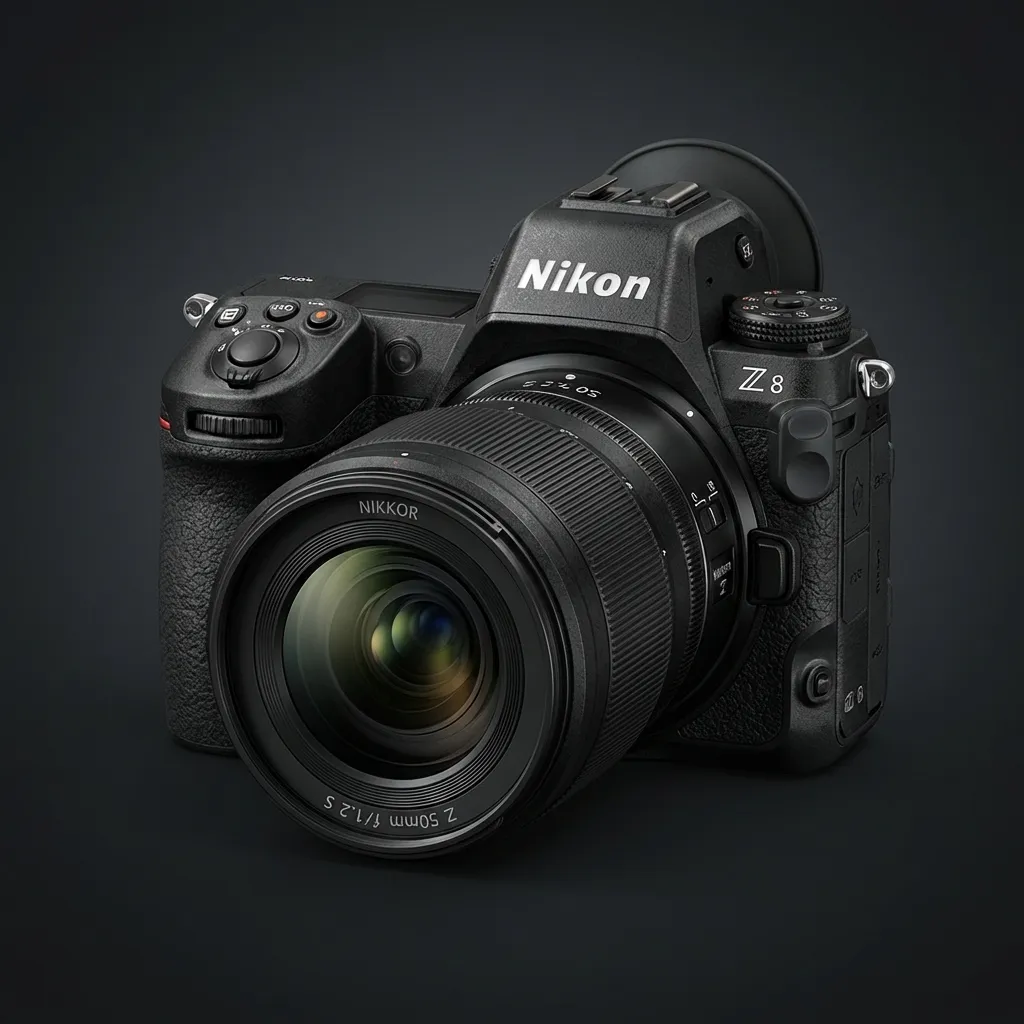
The Nikon Z8 is essentially a "baby Z9." It has no mechanical shutter because it doesn't need one—the sensor readout is instantly fast.
For pros who switch between high-res wedding portraits and 8K video, this is the ultimate hybrid. It’s bigger than a Sony A7 IV but feels incredibly balanced with pro lenses.
| Imaging | |
|---|---|
| Sensor | 45.7MP Full-Frame Stacked CMOS |
| Processor | EXPEED 7 |
| Stabilization | 5-Axis IBIS (6.0 stops, Synchro VR) |
| ISO Range | 64-25,600 (exp. 32-102,400) |
| Autofocus | |
| AF Points | 493 Phase-Detection Points |
| AF System | 3D-Tracking + Subject Detection (9 types) |
| Burst Speed | 20 fps RAW, 30 fps JPEG, 120 fps (11MP) |
| Video | |
| Max Resolution | 8.3K 60p N-RAW / 4.1K 120p |
| Internal Rec | 12-bit N-RAW / ProRes RAW HQ, 10-bit ProRes 422 HQ |
| Profiles | N-Log, HLG, SDR |
| Video Features | Pre-Release Capture, Waveform, Red Frame Indicator |
| Build & Connectivity | |
| Viewfinder | 3.69M-dot OLED EVF (3000 nits, blackout-free) |
| Screen | 3.2" 4-Axis Tilting Touch (2.1M-dot) |
| Card Slots | CFexpress Type B + SD UHS-II |
| Ports | Dual USB-C (Data+Power), Full HDMI, Mic, Headphone, 10-pin |
| Weather Sealing | Professional Grade Weather Sealing |
| Weight | 910g (body only) |
What We Like
- Zero rolling shutter (thanks to stacked sensor)
- Internal 12-bit RAW video recording (N-RAW)
- Incredible 45.7MP still image quality
- Pre-Release Capture ensures you never miss a moment
Trade-offs
- Battery life is just average (smaller EN-EL15c)
- Can get warm during extended 8K recording
- Still heavy compared to Sony/Canon mirrorless
- CFexpress Type B cards are expensive
In-Depth Performance
Image Quality & Sensor Performance
The 45.7-megapixel stacked CMOS sensor delivers exceptional image quality with outstanding dynamic range of approximately 14+ stops at base ISO. The stacked architecture enables remarkably fast readout with virtually zero rolling shutter—a first for full-frame cameras. Detail is exceptional, resolving fine textures in landscapes, architecture, and commercial work with medium format-like clarity.
High-ISO performance is impressive for the resolution class—ISO 6400 produces clean, usable images with excellent color retention. The EXPEED 7 processor enables efficient noise reduction while preserving detail. Color science is classic Nikon: accurate, neutral, and highly responsive to editing. The 14-bit RAW files contain exceptional latitude for post-processing.
Autofocus & 3D Tracking
Nikon has finally caught up—and arguably surpassed—the competition. The 3D Tracking system is remarkably sticky, maintaining focus on fast-moving subjects through complex backgrounds. Subject detection recognizes people (face/eye), animals (dogs, cats, birds), and vehicles (cars, motorcycles, airplanes, trains) with impressive accuracy. The system switches between subjects intelligently.
With 493 AF points covering approximately 90% of the frame, there's minimal need to recompose. Low-light AF works reliably down to -7 EV with fast lenses. The Pre-Release Capture buffers up to 1 second of images before the shutter is fully pressed, ensuring you never miss the decisive moment. Burst shooting at 20 fps (RAW) is fast enough for any action.
Video Capabilities
The Z8 is one of very few cameras offering internal 8K 60p N-RAW recording—12-bit footage that's extraordinarily malleable in post. 4K 120p provides buttery smooth slow motion with excellent detail. N-Log and HLG profiles deliver approximately 13 stops of dynamic range. ProRes RAW HQ is available for external recording via the full-size HDMI port.
Heat management is excellent for a fanless design—8K recording is sustainable for 90+ minutes with latest firmware. 4K 60p is essentially unlimited. The 4-way tilting screen (including vertical orientation) is invaluable for video work. Rolling shutter is virtually eliminated thanks to the stacked sensor. Focus breathing compensation works with supported Z-mount lenses.
Ergonomics & Build
The Z8 is designed for working professionals. The deep grip accommodates even large telephoto lenses comfortably, and the backlit buttons enable confident operation in darkness. The 3.69M-dot OLED EVF (0.8x magnification) is bright and lag-free with minimal blackout during continuous shooting. The 4-way tilting screen is a portrait photographer's dream.
Build quality is exceptional with full magnesium alloy construction and comprehensive weather sealing. The EN-EL15c battery provides approximately 340 shots per charge (CIPA)—average for mirrorless but supplemented by USB-C Power Delivery for continuous operation. Dual CFexpress Type B slots handle the massive file sizes from 8K video and high-resolution bursts. Weight (910g) is heavier than Sony/Canon equivalents but feels balanced with pro lenses.
Affiliate Disclosure
We buy our own gear or rent it. No manufacturers paid for this review. We earn a commission if you use our links, which keeps this site ad-free.
How It Compares
| Spec | Nikon Z8 ★ | Canon R5 II | Sony A1 |
|---|---|---|---|
| Price | $3,996 | $4,299 | $6,498 |
| Sensor | 45MP FF Stacked | 45MP FF Stacked | 50MP FF Stacked |
| Video | 8K60 N-RAW | 8K60 RAW | 8K30 |
| AF Points | 493 points | 1053 zones | 759 points |
| Burst | 20 fps | 30 fps | 30 fps |
| IBIS | 6 stops | 8.5 stops | 5.5 stops |
Recommended Accessories
Essential gear to maximize your Nikon Z8 experience:
Memory Card
Lexar CFexpress Type B 256GB
Fast enough for 8K N-RAW and 20fps bursts. Essential for professional work.
Pro Telephoto
Nikon Z 100-400mm f/4.5-5.6 VR S
Incredible reach for wildlife and sports. Sharp, fast AF, weather-sealed.
Extra Battery
Nikon EN-EL15c
Z8 battery life is modest. Carry 4-5 for all-day professional shoots.
Battery Grip
Nikon MB-N12
Doubles battery life and improves vertical shooting ergonomics.
Frequently Asked Questions
If you shoot professional sports, wildlife, or events—yes. The Z8 has 45MP (vs 24MP), faster burst speeds, 8K video, and dual CFexpress slots. The Z6 III is excellent for most users, but the Z8's resolution and speed justify the price for demanding work.
They're extremely close. The Z8 is $1500 cheaper, has better ergonomics, and superior battery life. The A1 has a slight edge in autofocus refinement and lens selection. Both are class-leading hybrid cameras—choose based on lens ecosystem. If you're already in Nikon glass, the Z8 is a no-brainer.
Start with the 24-120mm f/4 S for versatility, or the 24-70mm f/2.8 S if you need f/2.8. For sports/wildlife, the 100-400mm f/4.5-5.6 VR S is phenomenal. The 50mm f/1.8 S is cheap and tack-sharp. Avoid adapted F-mount lenses—native Z glass unlocks the camera's full potential.
Nikon engineered excellent heat dissipation. With the latest firmware, you can record 8K for 90+ minutes continuously. In 4K60, overheating is essentially a non-issue. The fanless design stays silent, making it perfect for interviews and quiet environments.
The Z8 is arguably the best mirrorless camera for wildlife. The 20fps RAW burst, pre-release capture, and subject detection (birds, animals) are incredible. Pair it with the 180-600mm f/5.6-6.3 VR or the 400mm f/4.5 S for reach. File management is critical—invest in dual 256GB CFexpress cards minimum.
Related Reviews

Written by cameraupick Editorial Team
Our team of professional photographers and videographers has 10+ years of experience testing cameras. We buy our own gear and provide honest, unbiased reviews.
Learn more about our testing process →