Ricoh GR IIIx Review
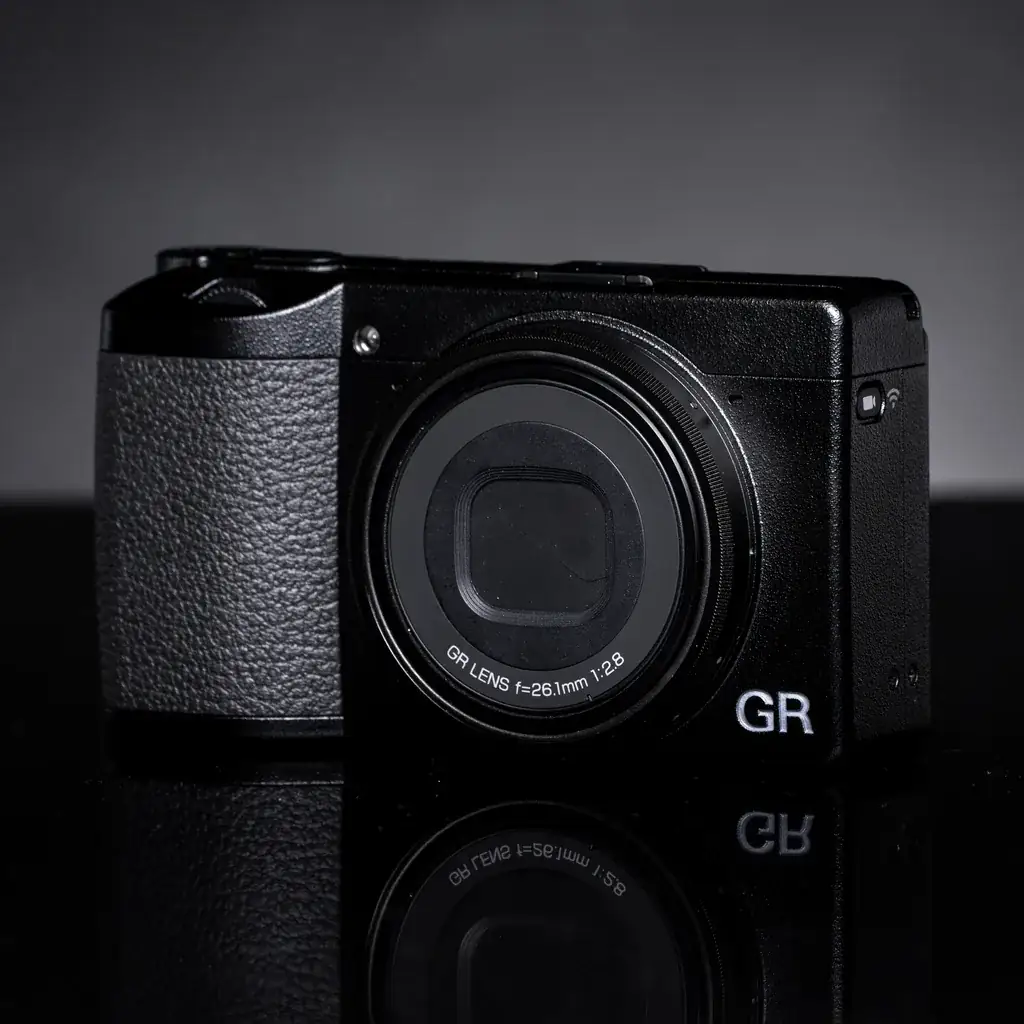
The GR IIIx is a camera that removes options on purpose. One focal length, no viewfinder, no zoom — and an APS-C sensor in a body that genuinely disappears into a jacket pocket.
Disclosure: links to retailers on this page are affiliate links. We earn a commission on purchases made through them, at no extra cost to you. It doesn't change our verdicts.
The Verdict
The argument for the GR IIIx is that the best camera is the one you have. It weighs 262 grams, switches on in about a second, and the 40mm equivalent lens sits closer to how people actually frame than the 28mm of the standard GR III.
Snap focus is the feature that makes it work on the street: preset a distance, and a full press fires instantly with no autofocus delay. The trade is real — battery life is short, there is no weather sealing, and dust in the sensor chamber is a documented long-term issue on this series.
| Announced | September 2021 |
|---|---|
| Sensor | APS-C CMOS (23.5 × 15.6 mm), approx. 24.24 effective megapixels |
| Resolution | 6,000 × 4,000; 14-bit raw (DNG) and JPEG |
| Lens | 26.1 mm f/2.8–f/16, approx. 40 mm equivalent; 7 elements in 5 groups, 2 aspherical |
| Stabilisation | Sensor-shift Shake Reduction, 3-axis |
| AA filter simulator | Moiré reduction using the SR unit — off, low or high |
| Autofocus | Hybrid — image-plane phase detection and contrast |
| Snap focus | 1 m, 1.5 m, 2 m, 2.5 m, 5 m, infinity |
| Focus range | 0.2 m to infinity; macro 0.12–0.24 m |
| Shutter speeds | 30s to 1/4000s (1/2500s at f/2.8, 1/4000s from f/5.6); timed exposure 10s to 20 min, bulb, time |
| ISO | 100–102,400 |
| Video | Full HD 1,920 × 1,080 at 60p/30p/24p, MPEG-4 AVC/H.264 (MOV); up to 25 min or 4 GB per clip |
| Rear screen | 3.0-inch TFT, 3:2, approx. 1,037k dots, air-gapless tempered glass; fixed |
| Viewfinder | None |
| Exposure modes | Program, aperture priority, shutter priority, manual, snap distance priority |
| Dust removal | Ultrasonic sensor cleaning (DR II) |
| Storage | Approx. 2 GB internal, plus SD / SDHC / SDXC (UHS-I) |
| Battery | DB-110 — approx. 200 shots to CIPA |
| Connections | USB-C: charging, MTP data transfer, DisplayPort over USB-C |
| Wireless | Bluetooth 4.2 LE, Wi-Fi |
| Dimensions | 109.4 × 61.9 × 35.2 mm, excluding protrusions |
| Weight | 262 g with battery and card; 232 g body only |
Maker-published figures, with source and date: Numbers & Sources below.
What We Like
- APS-C image quality in a genuinely pocketable body
- 40mm equivalent is a more natural framing than 28mm
- Snap focus eliminates autofocus lag on the street
- Starts up and shoots in about a second
Trade-offs
- Battery life is roughly 200 shots
- No viewfinder and no weather sealing
- Dust in the sensor chamber is a known long-term fault on this series
- 1080p only — video is an afterthought
In Depth
Snap focus, and why it defines the camera
Preset a distance — 1 m, 1.5 m, 2 m, 2.5 m, 5 m or infinity — press the shutter fully, and the camera fires without waiting for autofocus to converge. On a 40 mm equivalent stopped down to f/8, the depth of field covers most of the distances street photography actually happens at. The result is a camera that responds at the speed of the decision rather than the speed of the focus motor, which no amount of autofocus improvement replicates.
The 40 mm framing
The standard GR III uses a 28 mm equivalent; this one uses 26.1 mm giving approximately 40 mm. That gap matters more than it sounds. 28 mm asks you to get close and accepts distortion at the edges of a face; 40 mm sits near how people describe what they saw. If you already know you think in 28 mm, buy the GR III instead — the bodies are otherwise near-identical and this is the only decision that separates them.
Image quality
An APS-C sensor of 23.5 × 15.6 mm and approximately 24.24 effective megapixels, the same sensor class interchangeable-lens bodies use, sitting behind a seven-element lens designed for exactly this one sensor and nothing else. That is the advantage a fixed lens buys: no compromise for a zoom range, no compromise for a mount standard. Files are 6,000 × 4,000 in 14-bit DNG.
Stabilisation and the AA filter simulator
Shake Reduction moves the sensor on three axes. The same unit also drives the AA filter simulator, which vibrates the sensor by a sub-pixel amount to suppress moiré — off, low or high — giving you the choice between maximum detail and safety on fabric and architectural patterns. Very few cameras let you decide that per shot.
Size, and what it costs
109.4 × 61.9 × 35.2 mm and 262 g with battery and card. It fits a jacket pocket, which is the entire argument — a camera in a bag at home takes no pictures. The bill comes as roughly 200 shots per charge on the CIPA measurement, no viewfinder, no weather sealing, and a sensor chamber that this series has a documented history of collecting dust in.
Video is not the point
Full HD at 60p, 30p or 24p, H.264 in a MOV container, capped at 25 minutes or 4 GB per clip. There is no 4K mode. Treat video here as a note-taking feature rather than a reason to choose the camera; every competitor at this size records 4K.
The numbers, and where they come from
Published by the maker
| Sensor size (maker's figure) | 23.5 x 15.6 mm |
|---|---|
| Effective pixels | 24.24 MP |
| Pixel dimensions (3:2) | 6,000 x 4,000 |
| Native ISO range | ISO 100–102,400 |
| Battery (CIPA) | 200 shots |
| Weight with battery and card | 262 g |
Maker figures checked on 25 Sept 2026 — maker's spec sheet
Computed from those figures
| Pixel pitch | 3.92 µm |
|---|---|
| Sensor area | 367 mm² |
| Format factor | 1.53x |
| Light gathered vs 35mm | −1.2 stops |
| Print at 300 dpi | 51 cm |
| Diffraction limit | f/5.8 |
Computed from the figures above. Pixel pitch = sensor width / pixel count across. Light gathered = log2 of the area ratio to 36 x 24 mm. Diffraction limit = the aperture at which the Airy disc diameter (2.44 x lambda x N, lambda = 550 nm) reaches two pixel pitches. Other calculators use other thresholds and so quote other numbers.
How this score is put together
6.7 out of 10
- Image quality Weight 25% 8.2
24MP APS-C in a 262 g pocket body
- Autofocus Weight 20% 6.4
hybrid AF, slow to acquire
- Video Weight 20% 4.5
1080p60 only, no 4K at all
- Speed Weight 15% 5.8
4 fps, and the buffer fills almost immediately
- Handling and build Weight 20% 8.0
3-axis shake reduction, snap focus, genuinely pocketable
Scored against fixed-lens compacts. The overall figure is the weighted mean of the rows above — it is computed, not set by hand.
How It Compares
| Spec | Ricoh GR IIIx | Fujifilm X100VI | Sony ZV-1 II |
|---|---|---|---|
| Sensor | 24MP APS-C | 40MP APS-C | 1" 20MP |
| Video | 1080p60 | 6.2K30 | 4K30 |
| AF Points | Hybrid | 425 points | 315 points |
| Burst | 4 fps | 11 fps | 24 fps |
| IBIS | 3-axis | 6 stops | Digital |
| Buy | Check price | Check price | Check price |
Recommended Accessories
Essential gear to maximize your Ricoh GR IIIx experience:
SanDisk Extreme 128GB
More than enough for 24MP stills and 1080p.
K&F Concept 25-in-1 (APS-C)
16mm swabs for the known dust issue on this series.
Peak Design Slide Lite
Slim strap that suits a pocket camera.
Peak Design Everyday Sling 6L
Carries the GR plus a spare battery and cards.
More gear guides: Best TripodsBest Camera BagsBest SD Cards
FAQ
GR IIIx or GR III?
Only the lens differs: 40mm equivalent here, 28mm on the GR III. Pick 40mm for portraits and detail, 28mm for tight interiors and classic street.
Is the dust problem real?
It is a documented complaint across the GR series. It does not affect every unit, but plan on sensor cleaning being part of ownership.
Can it replace a mirrorless camera?
As a second camera you always carry, yes. As your only camera, the missing viewfinder, fixed lens and 1080p video are hard limits.