cameraupick

Canon EOS R8 Testbericht

The lightest full-frame camera on the market. Incredible autofocus and Canon color, perfect for upgrading from a phone.
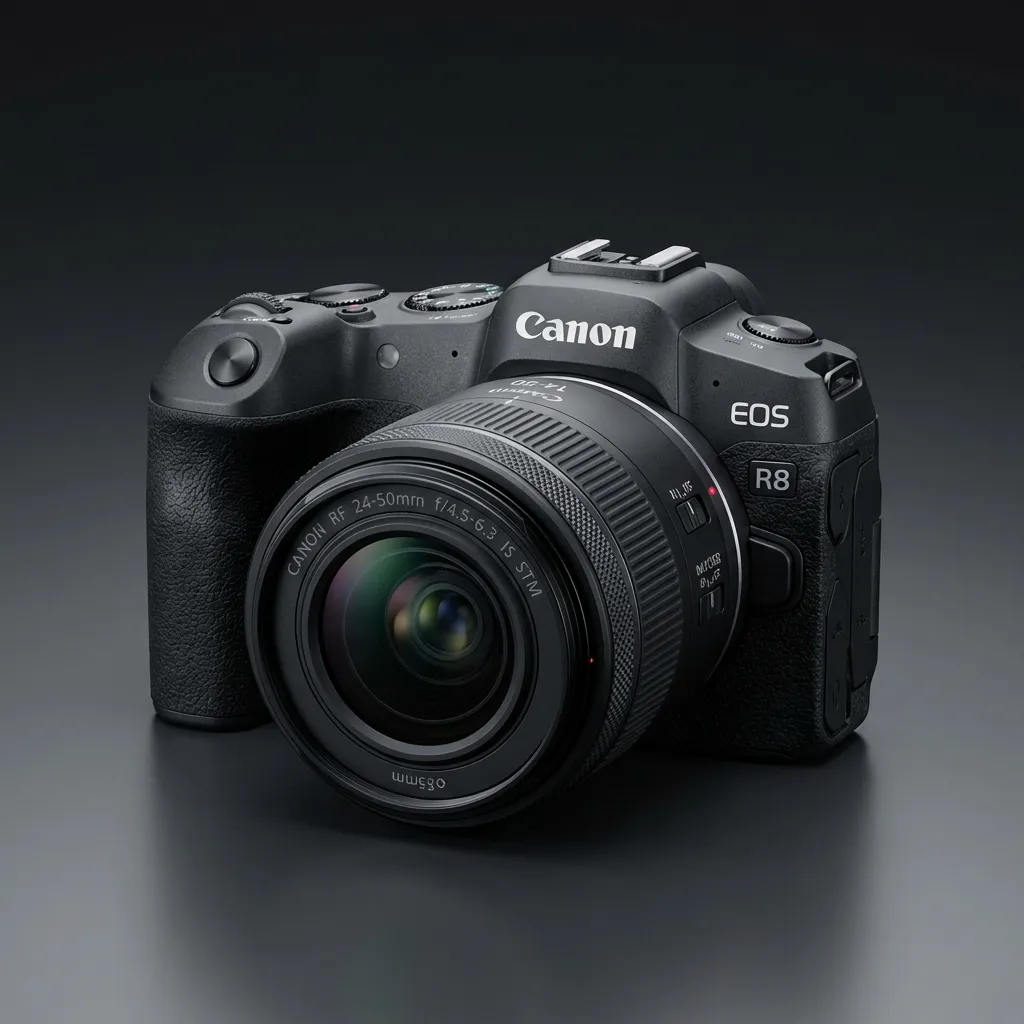
Entry Vollformat · 1.299 €
Canon EOS R8 entry-level full-frame camera with compact design
🚀 Best Value Vollformat Canon EOS R8 Product Shot

Das Urteil

The Canon EOS R8 is a wolf in sheep's clothing. It packs the same powerful sensor and autofocus system as the pro-level R6 Mark II but stuffs it into a tiny, lightweight body.

It’s the easiest path to that "professional look" (blurry background) without carrying heavy gear. The only compromise is the smaller battery and lack of IBIS, but for travel and portraits, it's unbeatable value.

Sensor 24MP Vollformat
Video 4K60 (Uncropped)
Gewicht 461g
Battery LP-E17 (Small)
Preis auf Amazon prüfen →

Was uns gefällt

  • Incredible subject tracking just like the R6 II
  • Beautiful Canon colors straight out of camera
  • Uncropped 4K60 video (rare at this price)
  • Usefully light and compact

Die Nachteile

  • Battery life is short (buy a spare!)
  • No In-Body Image Stabilisierung (IBIS)
  • Single SD card slot handled via battery door

Detaillierte Leistung

Autofocus

This is where Canon shines. The Dual Pixel CMOS AF II tracks people, animals, and vehicles with uncanny accuracy. It’s "point and shoot" simplicity with professional results.

Video Quality

Unlike many competitors that crop 4K60, the R8 gives you the full sensor width. This is huge for wide-angle vlogging or slow-motion B-roll. Just watch out for rolling shutter in fast pans.

Handling

It feels like an entry-level Rebel DSLR but shoots like a pro mirrorless. The lack of a joystick is mitigated by the excellent "touch and drag" AF on the screen.

Ideale Objektive

Travel All-in-One

RF 24-105mm f/4-7.1 — versatile, light, and surprisingly sharp.

Vlogging

RF 16mm f/2.8 — tiny, ultra-wide, and affordable.

Portrait background blur

RF 50mm f/1.8 — the "nifty fifty" essential for that pro look.

Partner-Hinweis

We buy our own gear or rent it. No manufacturers paid for this review. We earn a commission if you use our links, which keeps this site ad-free.
Häufig gestellte Fragen

Canon cut costs by removing IBIS, the second card slot, weather sealing, and the top LCD. The R8 uses a plastic build instead of magnesium alloy. However, it has the same 24MP sensor and AF system as the R6 II, so image quality is nearly identical.

Only if you shoot slow shutter speeds handheld or use non-stabilized lenses. Most modern RF lenses have IS (image stabilization), which works great with the R8. For video, enable digital IS in camera. For stills, just keep your shutter speed above 1/focal length and you'll be fine.

The R8 has more rolling shutter than the A7 IV due to the slower sensor readout. Fast pans and quick movements can show some wobble. It's not terrible, but noticeable if you're coming from a Sony or doing a lot of handheld video. The R6 II is better in this regard.

RF lenses are the future and offer better optics, but EF lenses via the adapter work flawlessly. If budget is tight, buy used EF lenses—they're cheaper and supported. Long-term, invest in RF glass, especially the affordable f/2.8 Trinity zooms or f/1.8 primes.

Absolutely. The R8 has much better autofocus (Dual Pixel II vs old system), 4K60p video (RP maxes at 4K25p), and faster burst shooting. The RP is now heavily discounted but feels outdated. For only 200 €-300 more, the R8 is a significant upgrade.

Verwandte Testberichte